



If you are reading this, you are probably like me and love to eat. Growing up on a farm with six siblings meant we jumped on all the food we could get. That especially applied to fish and chips, since your fish was private property but the chips were in the commons. Predictably, the chips—what Americans call fries—were depleted first.
The challenge is that body fat, beyond an optimal level, undermines performance in athletic contexts. My rule of thumb is that each pound of excess body fat equates to an extra minute over a marathon. Assuming you have excess fat to lose, cutting 20 pounds—about 10 kilograms—is likely to shorten your finish time by 20 minutes.
This post's sponsor is Green Pasture, my favorite outlet for healthy fats, especially cod-liver and butter oil and bison tallow. Use the FERG coupon code at GreenPasture.org.

This applies to many sports, not just the marathon. In the lead-up to my final competitive single-scull race, I considered ways to squeeze out an extra length or two of speed. One idea came to mind: getting leaner to improve my power-to-weight ratio. Eliminating potatoes from my diet for a few weeks did the trick, and I won the senior national title by open water.
Body composition is a sensitive topic, and my goal is to offer healthy, sustainable strategies. After a DEXA scan at Colorado State University, I discussed the results with the laboratory director and asked about CSU athletes taking the test. He shared that it was no longer part of the programs because too many athletes developed eating disorders.
Ideally, athletes work with a sports-oriented dietitian. Even if you pay close attention to your nutrition, accountability and fresh perspectives help. Plus, a skilled dietitian can give precise estimates regarding the nutrients you need en route to your ideal physique.
Over two summers—2023 and 2024—I utilized Kierston Murphy of Proactive Nutrition Consulting, and I recommend her. An athlete in her own right, she has an office in Cheyenne, Wyoming, and she is available for online support. If you are focused on avoiding diabetes or obesity, consider Steve Cooksey, AKA the Diabetes Warrior.


There are three broad factors driving excess body fat:
high-glycemic-index foods, those that spike our blood sugar;
frequent snacking, which means less time for fat burning;
a calorie surplus, when energy consumption exceeds expenditure.
Two accessible sources expand on these points:
Fat Head (2009), a humorous documentary in response to Super Size Me (2004), which was popular but misleading;
“The Mystery of Weight Loss,” a podcast episode of Jimmy Akin’s Mysterious World.
I will assume you are training for your target sport within the constraints of your schedule. The following ideas are for gradual fat loss, ideally over half a year or more.
Fast weekly. Die-hards fast for an entire day. My recommendation is to start gently with fasting until noon and then, when ready, until 6 p.m. That way you give yourself 14–20 hours without spiking your insulin. One can also flip this and start at noon.
Eliminate one sugary food. Most people have one item that is disproportionately undermining their physique, and this can be avoided or limited to no more than one day per week. Soft drinks or sodas, for example, are deleterious because the dissolved sugar rapidly enters one’s bloodstream. Others might be ice cream, fries, or chips—assuming they are common in your diet.
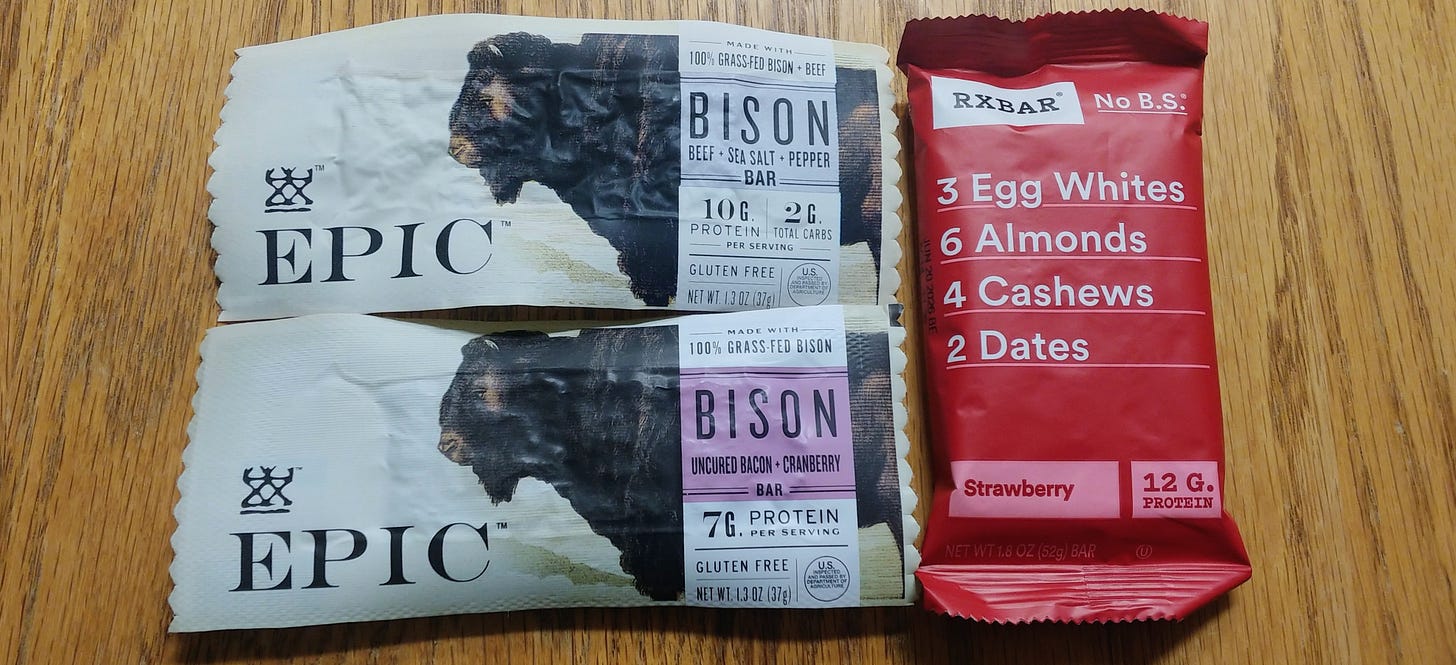
Take a protein supplement daily. While most people consume excess calories, athletes do not typically consume excess protein. Our musculature, especially as we age, is crucial to our performance, so any dieting best not limit protein. My own smoothie typically includes raw milk, a raw egg, and either whey or collagen as foundational. You can substitute this with an Epic bison bar or an RXBar.
Find a sweet-tooth substitute. This can be applied to many foods, but at least one would help. In my case, I have shifted to Primal Kitchen’s unsweetened ketchup. Stevia is a well-established option for sweetening smoothies, and I recommend chocolate with more than 70 percent cacao. Now that I am running out of my Honduran supply, Beyond Good is my go-to choice in the United States. Try the rum-raisin flavor!
Complete a weekly strength session. This might be counterintuitive, since it diverts attention away from sport-specific training. However, it goes with the protein supplement. Any fat reduction must not come at the expense of your musculature. At least one strength session will reinforce healthy hunger and stimulus for a resilient athletic frame. Some sort of whole-body circuit training, akin to crossfit, makes sense. If you want advice on this, Niki Veldman is my strength-for-running guru (email her).
Set a weekly weigh-in. At some point, your motivation will fluctuate down. A consistent weigh-in keeps us accountable, and you can get affordable scales that offer a rough measure of body composition. This is a useful data point, since weight loss alone is not the goal. A professional scale will give more accuracy, but it is not crucial.
Use a meal-prep service. These are not necessarily as healthy as home-cooked food, but they buffer against junk food when you are too tired to cook a proper meal. Some companies like Clean Eatz offer an extra-protein option. Factor is a well-known provider that delivers to your door, although that means a ton of packaging. In both cases, keep an eye on the ingredients, since undesirable additives creep in.

Please do not overdo the above. As I mentioned, the best fat loss happens incrementally, at about half a pound or quarter of a kilogram per week. That allows you to more easily maintain your refined frame on a long-term basis.
If you would like to book a consultation with me, please sign up here.